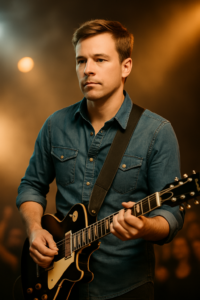
Aaron Blake
Rhythm Guitar & Harmony Vocals
Aaron Blake was born on August 22, 1976, in Boise, Idaho, to Mark Blake, an accountant who also served as his church’s treasurer, and Janet Blake, a schoolteacher and choir director. Faith was not a distant idea in the Blake household but something woven into everyday life. From an early age, Aaron was surrounded by music and ministry, with hymns in the morning, rehearsals in the evening, and a steady rhythm of church life shaping his worldview.
Growing up, Aaron was known for his quiet consistency. Where others chased attention, he found purpose in steadiness. His father’s disciplined and thoughtful nature, combined with his mother’s musical influence, created a balance that shaped him deeply. He was not the loudest voice in the room, but he was often the one others leaned on, the one who listened, who showed up, and who stayed.
Music became part of Aaron’s life early. At ten years old, he picked up a guitar at his mother’s encouragement, and what began as simple chords for church songs gradually grew into something more. He was not drawn to the spotlight, but to the structure behind the music, the rhythm, the harmony, and the way everything fit together. By high school, he was playing regularly in youth services, developing both his skill and a quiet confidence in his role.
Unlike many of his peers, Aaron did not wrestle with the same outward struggles, but his faith was not without depth. As he moved through his teenage years, it became something he chose, not simply something he inherited. He developed a growing desire to see others come to know the same truth he had been raised in, not through pressure but through relationship.
That desire led him to pursue college, where he felt called not only to continue growing musically but also to deepen his understanding of faith and purpose. College became a turning point, not because Aaron was searching, but because it was where his calling began to take shape in a new way.
It was there that he met Kyle Cross. At first, their connection was simple and rooted in music. Long jam sessions turned into long conversations, and Aaron quickly recognized something in Kyle, a talent, a drive, but also a restlessness he understood, even if he had not experienced it in the same way.
Aaron never set out to fix Kyle or force his beliefs on him. Instead, he did what he had always done. He showed up, he listened, and he lived his faith openly and consistently, allowing it to speak for itself. Their friendship grew naturally, built on mutual respect and a shared love for music.
Over time, those conversations deepened. What began as discussions about songwriting turned into conversations about life, purpose, and truth. Aaron answered questions when they came, but he never pushed. He understood that faith was not something he could manufacture in someone else; it had to be real.
When he eventually invited Kyle to a Campus Crusade meeting, it was not dramatic or persuasive, but simply an open door. When Kyle accepted, Aaron did not know exactly what would happen, but he trusted that God was already at work. Watching Kyle’s life change became one of the most defining moments of Aaron’s own journey. It confirmed something he had long believed, that faith lived out authentically could impact others in ways words alone could not. It was never about having all the answers but about pointing people toward the One who did.
As their friendship continued to grow, so did their music. What had once been casual jam sessions began to take on deeper meaning. Kyle started writing lyrics that reflected his transformation, and Aaron found himself shaping the sound around them, building structure, harmony, and rhythm that carried the message forward.
By their final year of college in 1998, what had begun as friendship and shared passion had become something more intentional. As others entered their lives with the same desire to use music for God, Aaron recognized it for what it was, not coincidence, but calling. While Kyle would become the voice and frontman of what would be known as Chasing Outcasts, Aaron remained the steady foundation behind it.
spotlight but
His rhythm guitar and accompanying vocals were never about drawing attention, yet without them, the sound would not hold together. In many ways, his role in the band reflected his role in life, supporting, strengthening, and helping others shine. For Aaron, the mission was never about recognition but about faithfulness, and through both music and friendship, he continues to live out that calling with quiet consistency and purpose.recognition but