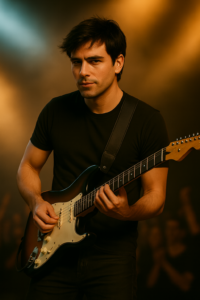
Caleb “Cal” Reyes
Lead Guitar
Caleb “Cal” Reyes was born on November 3, 1974, in San Antonio, Texas, to Miguel Reyes, an auto shop owner, and Lucia Reyes, a devoted mother whose Catholic faith shaped the rhythms of their home. Faith was present in Caleb’s upbringing, but more as tradition than transformation, expressed through Sunday Mass, quiet prayers, and religious symbols that filled the house without ever quite reaching his heart.
Growing up, Caleb was surrounded by both discipline and creativity. His father taught him the value of precision and hard work in the garage, while his mother nurtured his love for music, encouraging him to play at family gatherings and local events. From a young age, it was clear that Caleb had a natural gift. By his early teens, he could pick up melodies by ear and recreate them with ease, his guitar becoming an extension of who he was.
As he entered high school, that talent began to define him. Caleb quickly became known for his playing, drawing attention from peers and local musicians alike. With recognition came a growing sense of pressure and identity. Music became both his refuge and his escape, a place where he could feel in control even as other parts of his life felt uncertain. The faith he had grown up around began to feel distant, more ritual than reality, and he gradually drifted further from it.
By the end of high school, Caleb had already begun stepping into the local music scene, playing wherever he could and chasing opportunities that promised something more. There was always another gig, another crowd, and another chance to prove himself. Yet when the music stopped, the same questions lingered, questions he could not answer no matter how well he played.
After graduation, Caleb pursued audio engineering in Austin, Texas, while continuing to perform and collaborate with other musicians. It was a season marked by growth in skill, but also increasing restlessness. Relationships came and went, and success never quite satisfied the deeper longing he carried. He had spent years chasing sound, identity, and recognition, yet none of it seemed to fill the space he could not explain.
In the summer of 1998, a friend invited him to travel to Portland, Oregon, for a Christian music festival. Caleb did not go for the message but for the music. He had heard there would be open jam sessions, and that alone was enough to draw him in. Late one night, after most of the crowd had thinned, he found himself drawn toward a small group gathered around a campfire, where musicians were playing acoustic guitars and passing songs back and forth. Caleb joined in, instinctively finding his place in the rhythm, and what began as music soon became conversation.
Among that group were Kyle Cross and Aaron Blake. At first, Caleb listened more than he spoke. The conversation gradually shifted from music to faith, something he was familiar with but had never truly engaged with. What struck him was not only what they said but also how they said it. They spoke about God as if they knew Him personally, not as a distant figure or inherited belief. It was unlike anything Caleb had experienced.
He left that night without answers, but something stayed with him. After the festival, Caleb kept in touch, particularly with Aaron, and their conversations continued to grow. They exchanged ideas, recordings, and thoughts that reached beyond music. Over time, trust developed, and the questions Caleb had avoided for years slowly resurfaced, no longer easy to ignore.
When Aaron eventually called and invited him to be part of something new, a band forming around faith, purpose, and music, Caleb hesitated. He understood where he stood, and he knew he was not where they were. Yet something within him would not let him walk away, and in the end, he said yes.
It was not a moment of arrival, but the beginning of a journey. Over time, Caleb came to understand that faith was not about ritual or performance but about relationship. The same God he had kept at a distance was the One who had been pursuing him all along, and that realization began to reshape everything. During a late-night call with Aaron, he asked some tough questions. The answers he received led him to salvation and to give his life to Christ.
His playing changed, not in skill, but in purpose. What had once been about recognition became expression. His guitar became a voice for what words could not fully capture, carrying themes of struggle, surrender, and ultimately redemption.
Over the next year as Chasing Outcasts began to take shape in 1999, Caleb had found more than a band. He had found direction. Through every note he plays, that journey continues, telling a story not of perfection, but of being found.